Published: 10 June 2026
How to choose a team-building event people won't dread
The honest problem: most team-building feels awkward
Anyone who has organised a corporate event at least once knows the feeling: colleagues are polite afterwards, but nobody is talking about it the following week. That does not always mean the event was bad — often it simply was not interesting enough to create a shared memory.
The problem runs deeper than the choice of activity. In many formats some people participate actively while the rest watch — and that by itself creates a divide rather than cohesion. The best team event is not one where everyone is in the same room, but one where everyone has something to do.
The goal is shared memory, not forced fun. This guide helps you understand which questions to ask before choosing a format — and when different formats tend to work better or worse.
5 questions to ask before booking
Before contacting any provider, answer these five questions. They will help you quickly rule out unsuitable formats and focus on what will actually work for your team.
- —Can everyone participate regardless of fitness level? If the activity is physically demanding or requires specific skills, some participants end up as spectators rather than players.
- —What is the weather fallback? Outdoor activities are great, but you need to know whether the service runs in any weather or only when it is sunny.
- —Does the format scale from 10 to 100+ people? If the team grows or changes, it is worth knowing whether you will need to find a different provider for the next event.
- —Is everything at one venue, or does the group need to move between locations? Every additional transport leg is a potential headache and time loss.
- —What does the budget actually include? Attractive headline prices sometimes hide extra costs for catering, equipment or instructors. Find out the total bill, not just the entry fee.
How the main formats compare
Office workshops — creative, art, cooking — work well for a small team that is already fairly comfortable with each other. Working on a shared project or dish generates natural conversation. The downside: they easily become a passive demonstration where a few experts do and the rest watch; scaling is limited.
Escape rooms are excellent for bonding a small group — four to eight people, pressure, a shared problem. The difficulty comes when the team is larger: multiple parallel rooms create separate sub-groups rather than one team, and there is no shared experience to talk about afterwards.
Sports days — football, volleyball, field games — can generate great energy if the team is physically similar. When it is not — mixed ages, fitness levels, or physical limitations — the competition can create discomfort for those who do not feel competitive. Weather dependency is also significant.
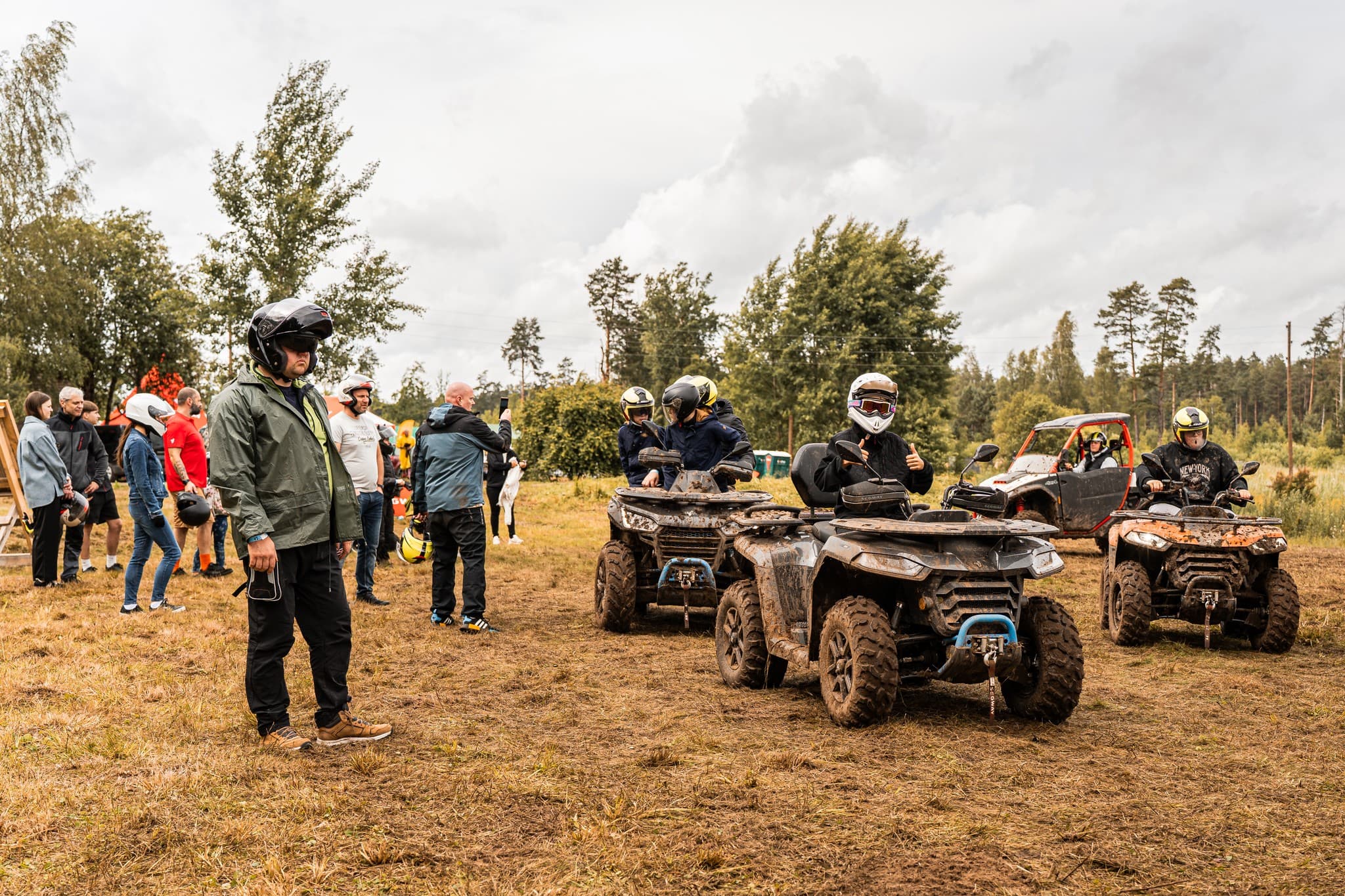
Adventure days with varied intensity — tactical games, shooting ranges, armoured vehicles — address several of the above limitations at once: participants can choose their level of engagement, one provider handles everything, and scenario-based activities generate stories worth telling long after the event.
Why a tactical day often works best for larger teams
Polygon X is designed for groups of 10 to 200+ people. The programme combines several activities with different physical intensities: airsoft battles, armoured vehicle rides, a shooting range and an obstacle course. Each participant can find an appropriate level of engagement — there are no players who never get a turn.
Spectators are welcome. If a participant does not want to take part in the airsoft game, they can watch and support their team — that in itself creates a sense of belonging and participation in the shared experience.
Catering is available on site, meaning the whole day takes place in one location without logistics between venues. Pricing starts from €50 per person — the final figure depends on the activity combination and group size, and can be clarified after an individual proposal.
Instructors and marshals take care of everything — safety, scenarios and the timetable. The organiser's only job on the day is making sure colleagues arrive on time.
Scenario-based activities create natural stories: who organised the tactical defence, who was first to climb into the armoured vehicle, who turned out to be unexpectedly precise at the range. These moments are remembered for weeks and months afterwards — not because anyone asked for them, but because they were real.
Practicalities
Polygon X is located in Salaspils, approximately 20 minutes from central Riga. Transport is arrangeable — if coordinating your own is inconvenient, we can help identify options.
Events run in all weather conditions. Protective equipment and clothing guidance are provided in advance, so rain or a cool day does not disrupt the programme.
After receiving an enquiry, an individual proposal is prepared within one business day. To start the conversation, write to info@polygonx.lv or WhatsApp (+371 26 464 303).
Booking at least two weeks ahead is recommended to secure your preferred date and activity combination. Demand is higher in summer, so earlier is better.
In closing: choose an event worth talking about afterwards
No event format is universal. An office workshop can be ideal for a small team's creative day; a sports day can work brilliantly for a physically active group. But if the team is large and diverse, and it matters that everyone — not just the most active — feels like a participant, then it is worth choosing something that creates an event, not just a process.
The best team events are the ones participants tell other people about — not because it was mandatory, but because it was worth telling.
Most team-building events feel forced or forgettable. This guide helps you choose a format that actually works — and explains why a tactical day may be the better alternative (from €50 per person, 10–200+ participants).
SEE THE CORPORATE PAGE